
LITHOPS VIRIDIS IN THE VELD
by Keith Green. Photographs also by the author unless otherwise stated.
It was on November 1st 1968 that Professor Desmond Cole and his wife Naureen first encountered Lithops viridis at the locality that became C127. 40 years later almost to the day they returned, but on this occasion my wife Debra and I were with them. In spite of the time lapse, C127 remains as both the type and only confirmed locality of this species.
All wild Lithops are difficult to find, but L. viridis is among the most difficult, restricted as it is to a tiny evolutionary niche in the Northern Cape of the Republic of South Africa. Although the general location is widely documented, in the interests of conservation the specifics are not. What I can say is that the colony grows at a remote spot, and that there are people in the vicinity (one of whom is actually a policeman) who are thankfully protective of it. My lack of Afrikaans (the preferred language of many in this area) was a further complication to getting access to the plants, but through their local knowledge and wealth of contacts the Coles had smoothed the way.
The drive to the locality however was far from smooth and could not have been achieved without a 4X4 vehicle. We were led to the site by a local contact who drove ahead in his own truck, leaving us to bump and scrape our way along behind him in the 4X4 we had hired in Cape Town. The scratching sounded expensive, but fortunately did no damage and the car survived the ordeal with nothing more than a slow puncture that we discovered the following day. As we made our way along I gradually became aware of a hillside that I had seen before by way of the photograph on p. 312 of Flowering Stones (2005) , a copy of which I had with me. When the profile of that hill matched perfectly with the photograph (Figure 01) our contact stopped and gestured to us that we were in the requisite place. We were on a low ridge and in a place of splendid isolation. Given that the Coles were with my wife and I, our contact trusted us to search out the plants for ourselves. He was rightfully confident that we would not remove any specimens as had apparently happened during the previous year! We thanked him and he drove away leaving us to commence our search for L. viridis among the rugged terrain.
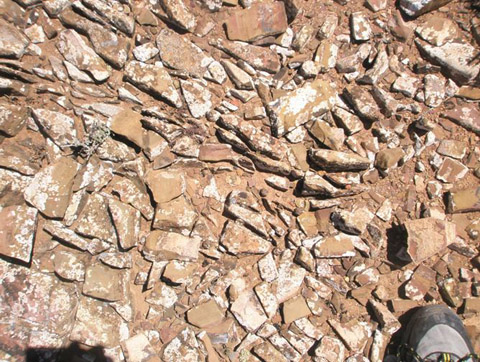
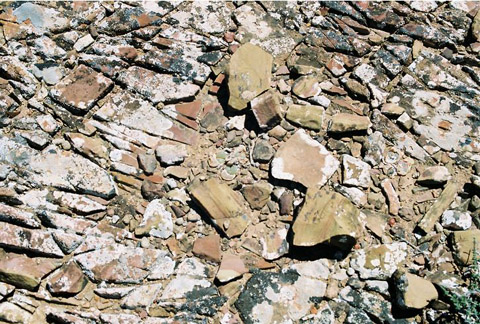
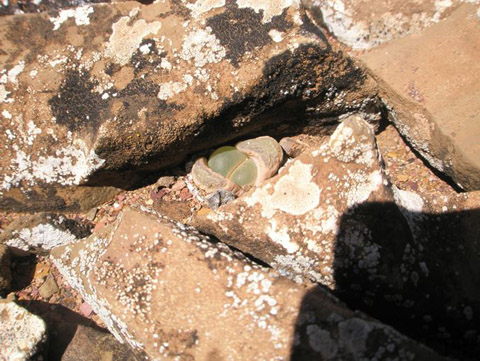
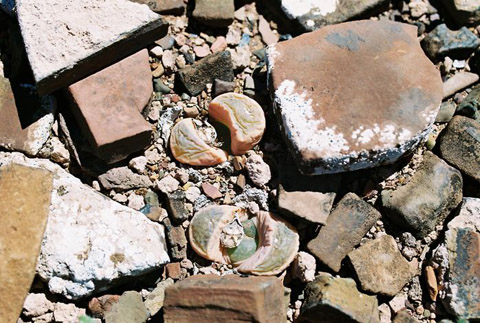
The plants were far from obvious, and after 15 minutes or so of searching by all 4 of us we had found nothing. I was beginning to get a sinking feeling when suddenly I heard a call from Naureen. This lady has many talents, but one of her most special is her ability to find Lithops when all around her fail. I immediately made my way over to her and saw my first L. viridis in habitat. Then, and as is so often the way, more specimens came into view. They were quite abundant in fact and had actually been under our noses and feet ever since we had stepped out of the car (Figure 02). Once the eyes become accustomed to the correct focus the plants were easy to spot (Figures 03-05), but to the casual onlooker they would remain quite invisible. I sometimes struggle with this species in English cultivation, so it was an absolute joy to me to see the plants growing how and where they were supposed to be (Figures 06-15). It was spring time in the Southern Hemisphere and the new growth was apparent as bright green faces pushing up between the withering leaves of the previous season. Seed capsules were also plentiful.
I now consider the old leaves an important factor in relation to the way this species camouflages itself in the veld. In cultivation we often think of our plants in their “Sunday Best”, which when considering Lithops equates to being fully turgid, fresh faced and without any old growth apparent. Nature of course has no such notion. The plants live and change throughout the seasons, and I venture the high light levels in South Africa make a significant difference to the colours in the leaves that is especially apparent as they shrivel away as part of their annual growth cycle. In my collection the green colour of L. viridis slowly fades as the old leaves wither with little blushing, but the plants in habitat were much more vivid.
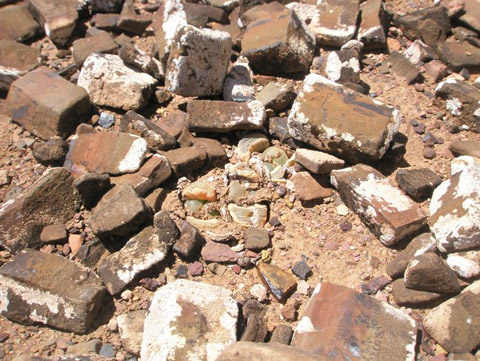
The stones among which the plants grow (and sometimes appear to be wedged) are shale, which at this locality generally present with either a grey-green or a rusty-red colour. Many of the fragments manifest both tones in differing degrees, sometimes with intermittent shades of buff, cream or brown also being present. Naureen pointed out that some rocks had what appeared to be a white lime encrustation on them, which was further interspersed with patches of grey-green lichen. Somewhat surprisingly to me I found all of these colour tones present in each of the L. viridis I saw at this locality in some degree or other. The green faces of the new growth matched with the grey-green shale, and the withering old leaves were often tinged reddish to match with the rusty-red shale. White (many seed capsules appeared white) or cream patches were also present in the withering leaves, which again matched perfectly with either the lime encrustations or the natural colour of the substrate and other parts of the shale. Further, the plants habit of growing beneath the level of the rocks not only seems to provide protection from the mouths and feet of large animals, but serve to break up the general appearance of the terrain further by casting tiny shadows. The combination of all these factors results in a very cryptic appearance that beautifully and effectively camouflages L. viridis by way of colour and texture. I do not know how the plants maintain their camouflage through all the seasons, but I somehow feel sure they do the job rather well.
We spent at least an hour at the locality, photographing and generally enjoying the plants in habitat before we had to leave. However, I made sure I took the time to appreciate the splendid isolation of this hot and remote locality before we departed. Long may L. viridis thrive there.
As a long standing student of Lithops this encounter was very special to me. Once again I am indebted to Naureen and Desmond Cole for their invaluable help and friendship. I am truly thankful to them both. I also extend my thanks to my wife Debra for accompanying us to the locality and for her sterling work in spotting Lithops.
As a postscript I make mention of the red (R- type) aberration of L. viridis that has occasionally turned up in cultivation. These are “plum-coloured” specimens (apparently not simply sun blushed greens) that were mentioned in both editions of Flowering Stones (p. 211 of the 1988 book and pp. 68 & 314 of the 2005 edition) and by Steve Hammer on p. 114 of Treasures of the Veld. I have only seen these by way of photographs (Figure 16) and did not find any growing wild, but none the less they do raise the prospect of a new cultivar. We shall see.





Cole, D.T. (1988) Lithops Flowering Stones. Randburg: Acorn Books.
Cole, D.T. & Cole, N.A. (2005) Lithops Flowering Stones. Milano: Cactus & Co.
Hammer, S.A. (1999) Lithops Treasures of the Veld. Ansty: British Cactus & Succulent Society
Hoes, F. Available at: www.users.skynet.be/fhoes/rsasucculents/lithops_plantlist.htm (Accessed: 19 January 2008).